
Choosing Between Liquid Cooling and Air Cooling for Your Operations
As the demand for AI, cloud services, and other rapid technologies grows, data centers face challenges in maintaining optimal temperatures, especially with traditional air cooling methods. According to the Data Center Trends 2025 report from Vertiv, rack densities could surge to 500-1000kW in AI facilities. This shift necessitates advanced cooling techniques to prevent overheating and avoid costly downtime.
Traditional air cooling systems are often insufficient for supporting high-density racks in data centers. Liquid cooling emerges as a superior option, effectively managing equipment heat and reducing the risk of overheating. Explore the differences between liquid and air cooling and determine the most suitable choice for your facility in this article.
Understanding Liquid and Air Cooling Methods
Efficient cooling systems are essential to maintaining your equipment’s performance and longevity. Both air and liquid cooling systems aim to dissipate heat, albeit through distinct approaches. Air cooling utilizes air to transfer heat away from IT components, serving well in environments with lower densities. It often employs precise cooling units to accommodate rack, row, and room requirements. Consider solutions such as the Liebert PDX Compact DX Cooling System or Liebert® CW Chilled Water Cooling System for a tailored approach.
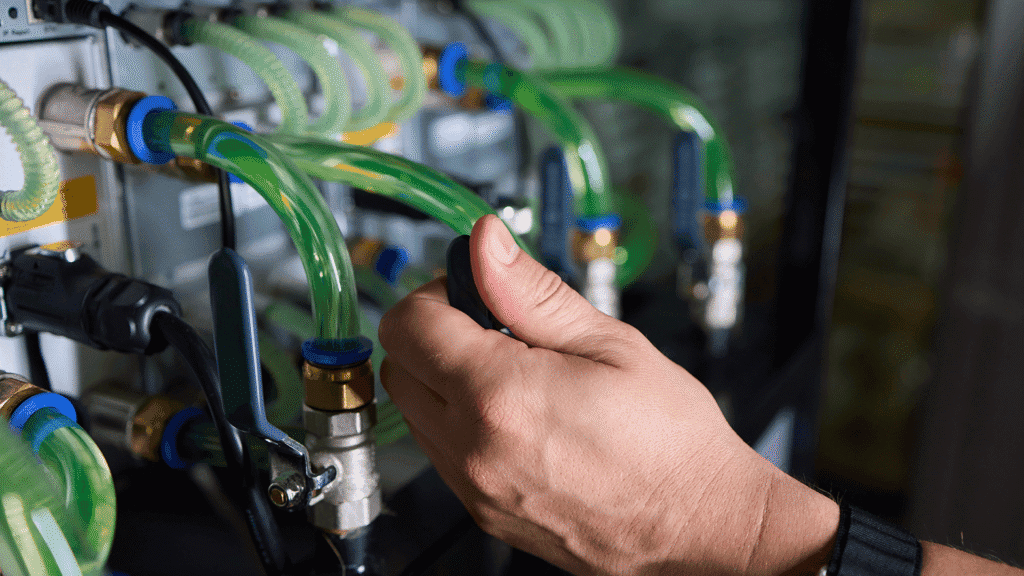
Liquid cooling, on the other hand, circulates water or specialized nonconductive fluids near your equipment, efficiently absorbing and regulating heat. It’s a more direct method, better suited for high-density environments. Liquid cooling can be implemented through:
- Direct-to-chip cooling: Delivers coolant directly to server chips, such as the Vertiv™ CoolChip CDU.
- Rear door heat exchangers: Removes heat from server racks with solutions like the Liebert® DCD Water-Cooled Passive Rack Door.
- Immersion cooling: Submerges entire servers in a nonconductive liquid to dissipate heat.
These methods provide a more effective cooling solution for facilities with high-density equipment.
Deciding on the Best Cooling Solution for Your Data Center
When choosing a cooling solution, consider the density of your rack systems. Low density racks, typically under 20kW, can be adequately cooled using air methods, as they produce less heat. In such cases, air room cooling systems like the Liebert DS Direct Expansion Cooling System are appropriate and cost-effective.
For high density racks using over 20kW, liquid cooling is advised, with strong consideration for racks consuming 30kW or more. Air cooling cannot efficiently manage the immense heat output of these high-power systems. A hybrid approach, utilizing both air and liquid cooling, might be the optimal strategy to maintain temperature and reduce operational costs.
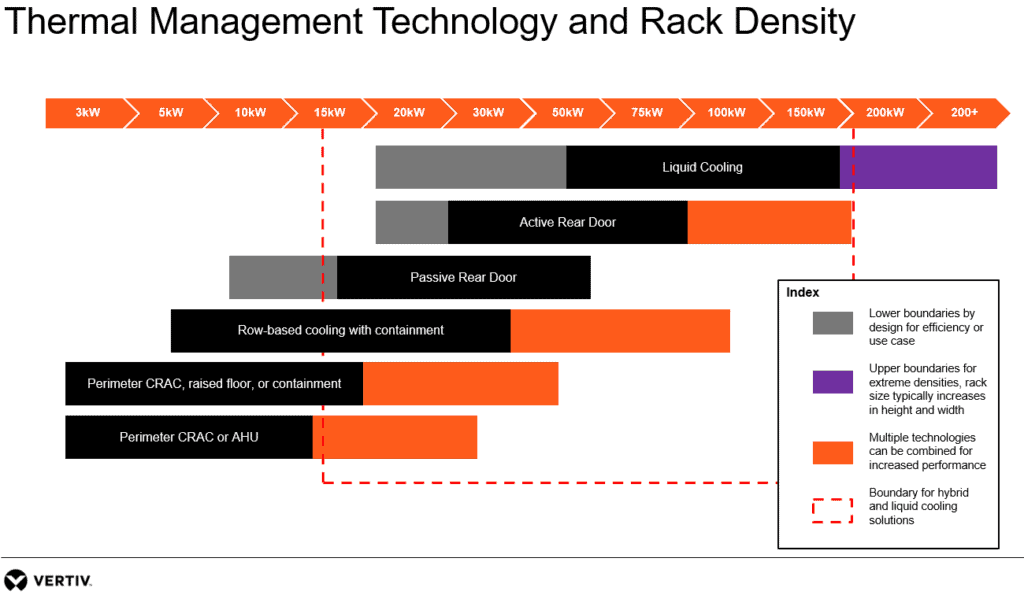
With advancements such as AI driving the need for higher density servers, hybrid cooling systems are becoming prevalent. They allow flexibility and efficiency, ensuring data centers adapt to changing cooling requirements. Products like the Vertiv™ CoolChip CDU cater to this hybrid model, providing liquid cooling to chips while using AC to maintain room temperatures, reducing energy consumption.
Ready to Optimize Your Facility’s Cooling Solutions?
Crafting the ideal environment for your equipment extends beyond just temperature and density considerations. It requires a strategic approach to ensure your setup is organized, secure, and updated with the latest technologies. Keeping up with these advancements can be challenging, but our experts at Innovative Support Systems Inc. are here to help. Contact us at 407.682.7570 to explore more about optimizing your cooling infrastructure.
Subscribe to our newsletter to stay informed about the latest cooling technologies and best practices to maintain efficient operations within your data center.
Frequently Asked Questions
What is the main advantage of liquid cooling over air cooling?
Liquid cooling offers a more efficient heat dissipation method, better suited for high-density data centers.
When should I consider using liquid cooling?
Liquid cooling is recommended for racks using over 20kW, especially for those consuming 30kW or more.
Can liquid cooling and air cooling be used together?
Yes, a hybrid approach utilizing both methods can optimize heat management and reduce costs.
What role does rack density play in cooling decisions?
Rack density greatly influences the choice between air and liquid cooling, as higher densities require more robust cooling solutions.
How does liquid cooling contribute to energy efficiency?
By directly managing heat at the source, liquid cooling reduces the energy needed for compressors, resulting in lower power usage.